


The 2026 Ugandan presidential election takes place onJanuary 15, 2026 to elect the President of the Republic of Uganda for a five-year term. Legislative elections are held simultaneously.
The previous presidential election in 2021 saw the incumbent president, Yoweri Museveni of the National Resistance Movement (NMR), win a sixth consecutive term with 58.38% of the vote.
In power since the overthrow of Milton Obote ‘s authoritarian regime in 1986, Museveni notably removed the two-term limit through a constitutional amendment in 2005, and similarly eliminated the age limit of 75 in 2017, in order to ensure his re-election.

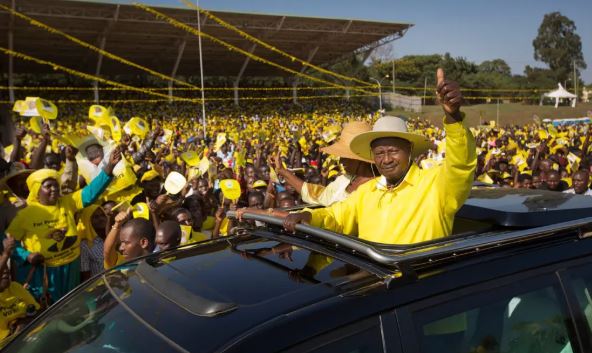 Museveni Campaigns in Otuke / Photo UBC TV Uganda
Bobi Wine, Museveni’s main opponent and the opposition candidate with the National Unity Platform (NUP), denounced the results as “a complete farce,” accusing the ruling party of electoral fraud.
The November 16, 2024 Kizza Besigye, the leading opposition figure and four-time presidential candidate, was arrested in Kenya and extradited to Uganda where he was accused of “conspiracy by force of arms to overthrow the government,” which carries the risk of the death penalty in that country.
Initially tried before a military tribunal, he obtained the, by the Supreme Court of Uganda, that military proceedings against civilians be suspended, but nevertheless remains in detention.
Electoral system
The President of the Republic of Uganda is elected by a two-round majority system for a five-year term, with no limit on the number of terms served. The candidate who obtains an absolute majority of the votes cast in the first round is elected.
If no candidate receives an absolute majority, a second round is held between the two candidates who received the most votes, and the one who receives the most votes is declared elected.
Chapter 142 of the Presidential Elections Act of 2000 stipulates that presidential candidates must be Ugandan citizens by birth and qualified to serve as Members of Parliament.
Candidates must also be of sound mind and have no formal connection with the Electoral Commission of Uganda. Term limits were abolished in 2005, Elections are overseen by the Electoral Commission.
Candidates
The August 28, 2025At a National NRM conference, Museveni was re-elected as its leader, without an opponent, for five years and confirmed as a candidate for the presidential election of January 2026 for a seventh term at the age of 80.
The August 18, 2025 The National Unity Platform (NUP) and the Democratic Party (DP) submitted a request to register candidates for the presidential election, The electoral commission officially authorized Bobi Wine to run for president.
This was Wine’s second candidacy after his 2021 bid, in which he came in second. However, he contested the election results, alleging irregularities such as electoral fraud, and filed an appeal with the Supreme Court, which he later withdrew.
Four women, including lawyer and activist Yvonne Mpambara, collected enough signatures to be considered potential candidates. However, none of them were nominated by the electoral commission.
Campaign
The months preceding the launch of the campaign were marked by several government actions targeting the main opposition party, the National Unity Platform (NUP). Ten NUP members are arrested in northern Uganda, while at least 95 others are charged with minor offenses in
The measures taken by the authorities against the NUP continued after the start of the election campaign.Bobi Wine , accompanied by several supporters and members of his team, was attacked and beaten by security forces while campaigning in Gulu.
Amnesty International describes the campaign as marred by a “brutal campaign of repression” targeting the opposition, citing in particular the use of tear gas , pepper spray , beatings, and other acts of violence.
In its end-of-year address delivered onPresident Museveni recommended that security forces make greater use of tear gas to disperse gatherings of what he called the “criminal opposition.


Robert Kyagulanyi, better known as Bobi Wine / Foto AFP
” He also justified the use of tear gas to disperse Bobi Wine’s supporters, stating that “it doesn’t kill” and that this method is “far preferable to the use of live ammunition.”
The Office of the United Nations High Commissioner for Human Rights also accused the government of waging a legal war, including through military regulations, to restrict the activities of political figures and opposition supporters in the run-up to the elections. [
Internet outage
On January 13, 2026, the authorities decided to prevent Ugandans from accessing the internet for an indefinite period. According to the Uganda Communications Commission.
“This measure is necessary to mitigate the rapid spread of disinformation […] online, electoral fraud and related risks, as well as to prevent incitement to violence”. Just a few days earlier, on January 5, the authorities had stated that they would not cut off internet access during the elections.
This same measure had been taken a few months earlier during elections in a neighboring country, Tanzania. Starting on October 29, 2025, during elections deemed fraudulent by international observers, the internet was shut down for five days.
This prevented the dissemination of images of killings by security forces. More than 2,000 people were reportedly killed, according to the opposition.[
Alphonse